Stay, Come & Follow
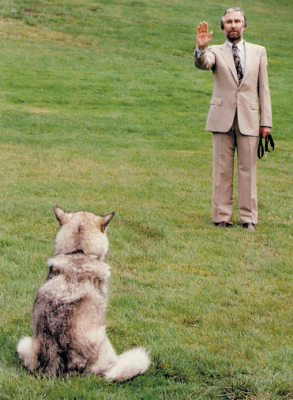
Stay Once your puppy changes body positions quickly and eagerly on request, delay rewarding your pup for a couple of seconds after each position change. Quietly praise your pup while he remains (stays) in the appropriate position. In fact, count out the seconds, "Good sit-stay one... good sit-stay two... good sit-stay three... etc."
Start with easily attainable goals, so your puppy can succeed. For example, three seconds for a Mastiff puppy, and just one second for a wriggly Labrador. And for toy breeds and terriers, the deal is easier yet — if you stay still for just a fraction of a second, frozen in time for a palpable moment — then you'll get a food reward. Next time try for a quarter of a second, then half a second, then a full second, then two seconds, three, five, eight, ten, fifteen seconds, and in no time at all, your puppy's stays will be measured in minutes. By gradually increasing the delay before rewarding your puppy on each successive trial, you are progressively increasing the length of the stay and phasing out the need for rewards.
Have competitions within the family to see who can withhold the food reward for the longest time while the puppy stays in each position. Vary the order of three body positions and make up your own sequences. For example, starting with a sitting puppy, instruct it in the sequence Down-Stand-Down-Sit-Stand-Sit. It is important to vary the lengths of stay in each in each position.
Come 1. With somebody holding your puppy, or while your puppy is playing, say "Joe Pup, Come." 2. Open your arms invitingly, waggle the food or toy lure in front of you, and praise your pup enthusiastically all the time he approaches. Remember, your puppy's first step towards you is the most important step to praise. Reward the puppy's first and subsequent steps towards you. 3. Once your puppy is within three to five dog-lengths, instruct your pup to “sit” and give the hand signal to sit with the right hand (palm upwards with food or toy lure enclosed). 4. Tell Joe Pup that you are overjoyed that he has successfully accomplished yet another wonderful and glorious recall. Maybe offer a food treat, or reward the pup with a game with his toy after especially zippy recalls, and then tell Joe Pup to "Go Play."
Whenever your puppy is off-leash, investigating or playing in the yard or park, instruct him to come to you every couple of minutes or so. However, give your puppy a food reward only for one out of every two recalls. Obviously, reward your pup after the faster recalls. If you reward your puppy after every recall, he may not learn that you want him to come quickly. In this exercise we are using food as a lure to entice the pup to come, and as an occasional reward to reinforce the puppy for coming quickly. However, the real rewards are your praise and the words "Go Play." Say nothing after slower recalls. Simply repeat the process. After a few trials your puppy will come so fast that small breeds will be hard to catch, and large breeds will flatten you. Consequently, it is a smart preemptive plan to instruct your pup to sit when he is homing-in and only three to five puppy-lengths away from potential impact.
Follow Let your puppy off-leash only in safe areas, (e.g., indoors, in a fenced yard, or in a dog park). Walk away from your puppy and he will follow you. There are two simple rules to entice your puppy to follow: 1. Keep moving... 2. Away from your puppy.
This may sound simplistic, but try it. I guarantee, in the space of a few seconds, the average three-month-old pup can train an off-leash owner to slow down, walk backwards, pirouette, stand-stay, recall, and follow. Remember, the puppy cannot follow you unless you are going somewhere. And, unless you are moving away from the puppy, you'll most certainly end up following him. That is not the aim of the game. The pup is meant to learn to follow you. And so, move off quickly, and keep moving away from your puppy at all times.
If your puppy tries to improvise when following, and starts to lag or heads off in an alternative direction, alert your pup to his transgression — "Oi! Come along," and dramatically accentuate your puppy's mistake by quickly zooming off in the opposite direction. Your puppy will smartly self-correct as if on a bungee cord. If your puppy slows down, speed up. If your puppy rushes on ahead, slow down, or turn about and run back from where you came. If your pup drifts left, turn right, and if the pup wanders right, turn left and speed up. Praise your pup the instant he starts to catch up.
Your puppy will quickly learn that he cannot divert his attention from you for a single second without you heading off in some new direction. Consequently, your pup will begin to pay attention and follow. For puppies that are too young to be walked on the streets because they have not yet completed their course of immunizations, the following exercises are easily practiced in the house and garden. Get your puppy to follow you inside and outside, upstairs and downstairs, into different rooms, and around tables and chairs. As Pat Parelli might say, preparatory private practice prevents predictable poor performance and problematic pulling predicaments in public places.
Regular, long, off-leash puppy walks (in safe areas) are the secret to calm and controlled on-leash walking. Your puppy needs to develop a centripetal attraction towards you. Your off-leash pup must always feel a gravity-pull towards the most important body in his universe — you. It is essential to develop off-leash owner-gravity before trying to walk your puppy on-leash. If your puppy doesn't walk close to you when off-leash, he will surely pull when on-leash. Pulling is basically an advertisement that your dog does not want to walk by your side, and presumably would not walk by your side if he were not restrained by a leash. Either your puppy considers that investigating the environment is much more interesting than you, or your puppy simply does not enjoy walking by your side because you keep jerking the leash to try to dissuade him from pulling. (By moving ahead and tightening the leash, the puppy reduces the pain of each jerk.)
Owner-gravity (following) exercises are time-sensitive. It is not safe to walk your puppy on public property until he is at least three months old, and by the time the puppy is 18 weeks old, following exercises start to lose effectiveness. Untrained adolescents soon develop doggy interests and would much rather sniff urine and feces, sniff other dog's rear ends, or simply sniff, than walk by their owner's side. It is much easier to teach off-leash following and closeness before your puppy reaches adolescence.
Take long walks and keep moving away from your puppy. Accentuate your pup's unwanted wanderings by smartly moving off in the opposite direction. Should your puppy get too far ahead, hide. Periodically, shout your pup's name. Remain hiding but keep an eye on your pup. Wait for the puppy to find you and then lavish him with praise. It is unlikely that you will be able to hide from your pup more than a couple of times. Perhaps your puppy thinks that he cannot take his eyes of you for a second without you getting lost. During each walk, remember to frequently instruct your pup to sit or settle down by your side. You can lure and reward your off-leash puppy to settle down beside you simply by holding a piece of rope with a stuffed chewtoy tied to the end.