


Dog Behavior

Dog behavior is a hugely fascinating yet widely misunderstood topic. All too often, normal play behavior and communication is misinterpreted as aggression and all too often, a myopic “understanding” of dog social behavior is used as an excuse for people to use aggression when training dogs.

In Chapter Seven: Dog Behavior & Play
The Alpha Fallacy
Dog Play
Dog Communication

The whole macho-dominance-alpha fallacy is just too much. If the alpha fallacy and its unwarranted and utterly misguided extrapolation to dog training were not so serious (and painful and potentially dangerous), the mere “concept” would be laughable. I hardly think that dogs meet secretly in late-night coffee bars to plot the overthrow and demise of their human families. To completely misunderstand the complexities of dog social structure and hierarchical interaction, to cite these misinterpretations as proof of the dog’s supposed desire for world domination, and then to use such flagrantly flawed “logic” as an excuse to make a dog’s education (training) a living hell is simply unthinking and unfeeling — both dumb and cruel.

Certainly, it is essential that we have household rules for dogs and that we take the time to adequately teach dogs our household rules and regulations, rather than punishing them for breaking rules that they never knew existed. And certainly, it is essential that we can modify and reliably control our dog’s behavior and actions at home and especially, when the dog is on public property. But surely we can accomplish this using brain instead of brawn… Yes, we should strive to use our supposedly superior human brains to teach our dogs, not only to act the way we want but also, to want to act the way we want. The secret to successful pet dog training is to respect, understand and engage dogs as dogs and to motivate them to be happily and willingly compliant, rather than coercing and forcing them to comply out of fear of mental anguish and physical pain. Indeed, in the world of pet dog training, wherein a large proportion of the trainers are children, happy and willing compliance is the only way.

Additionally, we should learn how to better understand and objectively interpret dog communication and dog play behavior to be able to ensure that our dogs are happy are neither stressed nor anxious, and that the behavior is normal and not potentially dangerous.

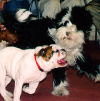
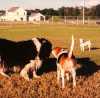
By observing repetitive play-signals, such as pawing, paw raising, play bows, or rhythmic or sudden staccato movements, it is possible to interpret the growls and yowls, snarls and snaps, and barks and bites as play rather than fear or aggression. Via preference testing — grabbing a playmates collar to see if the other puppy resumes or avoids continued interaction — it is possible to discern whether a puppy is being bullied, or having a darn good time. When dogs fight, we may objectively determine whether they are simply having a doggy disagreement (no injury is inflicted on either dog), or whether the behavior is dangerous (one dog is injured because the other has no bite inhibition).

AttachmentSize
10 Dog Behavior.pdf120.82 KB
 

Articles in this Chapter:

The Alpha Fallacy

The Alpha Fallacy
It is popularly held that rank is established and maintained by physical strength and dominance and that the more dominant (i.e., higher ranking) dogs are more aggressive. Hence, dogs that frequently threaten, growl, fight and bite are often assumed to be “alpha” animals. Not so Joe! The above assumptions are quite awry. Not only do they betray a theoretically simplistic view of a most sophisticated social structure but also, such notions tend to be counterproductive, inhumane and dangerous when cavalierly extrapolated to dog training, or the treatment of behavior problems.


Dog Play

Dog Play
Puppies and play are virtually synonymous. The very thought of a group of young puppies conjures up a picture of virtually non-stop, fun-loving, boisterous and bumbling play sessions. In fact young pups spend over 90% of their waking hours playing. But aside from the fun-factor, puppy play is also serious business. Play has many important functions. Puppies spend most of their play sessions practicing all-important hunting, fighting and survival skills. At four- to five-weeks-of-age, puppy play is characterized by puppies bumbling around, bumping into each other with frequent and amusing, bungled ambush attempts. But by eight weeks, most pups have become good little hunter-fighters and are quite adept and stalking, chasing and pouncing on their littermates.


Dog Communication

“In man, social intercourse has centered mainly on the process of absorbing fluid into the organism, but in the domestic dog and to a lesser extent among all wild canine species, the act charged with most social significance is the excretion of fluid. For man the pub, the estaminet, the Biergarten, but for the dog the tree trunk, the lintel of door or gate, and above all the lamppost, form the focal points of community life. For a man, the flavors of alcoholic drinks, but for a dog the infinitely variegated smells of urine are the most potent stimuli for the gregarious impulse.”
From The Lamppost, A Study of the Social Life of the Domestic Dog by Sirius (quoted in Sirius by Olaf Stapledon)