













Syndicate content

The Macho Myth

iStock_000005220082XSmall.jpg

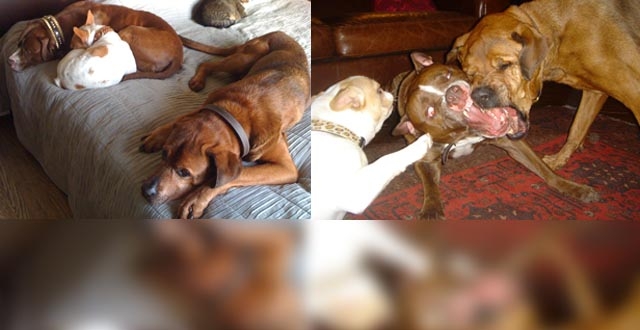
The social structure of domestic dogs is often simplistically described in terms of a linear dominance hierarchy, in which the topdog, or “alpha animal”, is dominant over all lower ranking animals, the second ranking dog is subordinate to the topdog but dominant over all others, and so on down to the lowest dog on the totem pole. Moreover, it is popularly believed that rank is established and maintained by physical strength and dominant behavior, that the more dominant (i.e., higher ranking) dogs are more aggressive and that the most dominant dog is the most aggressive. Hence, dogs that frequently threaten, growl, fight and bite are often assumed to be “alpha” animals. The majority of the above assumptions are quite awry. Nothing could be farther from the truth.


Retreat & Treat

I believe the term “Retreat ’n Treat” was first coined by Suzanne Clothier. I initially called the technique “Retreat With Honor” after getting into a dodgy situation with an Akita. Basically, we were much too close and the situation was beginning to escalate — the Akita growled and I reprimanded. Both of us desperately wanted to normalize the interaction without losing face.


Dog Star Daily

Position Changes & Stays

Once you have used all-or-none reward training techniques to teach your dog to sit- and down-stay, to pay attention, to walk on leash and not to touch, you will find that your dog is now so much calmer and that you have regained his attention. Now it is again possible to use the lure/reward training techniques that worked so well in puppyhood.


The Importance of Early Socialization

Socialization is the process of becoming familiar with all kinds of animals, people, places, and things; as well as learning how to behave in society. All puppies need socialization regardless of breed, type, or temperament. Please do not take this for granted, regardless of your breed description. Even dogs from breeds that have a very good reputation for loving people will need to be thoroughly socialized as puppies, to make sure that they have lots of great experiences being around all kinds of different people. And more importantly, breeds that are known to be less social (often described as aloof) must be socialized to grow up to love to be around people in order to be good canine citizens (and not end up in news headlines).


Take and Drop

Within the allotted one-minute time period, the dog must take an article from the handler and follow the handler’s directions, so as to drop the article as close as possible to a $100 bill, which is taped on the floor approximately 30 feet away. The article (usually a squeaky and/or soft toy) is supplied by the judge and is the same for each dog in any competition but is different for each competition. While giving directions to the dog, the handler must remain seated at all times. The handler is disqualified if the judge can see daylight between the handler’s butt and the chair. Once the dog has placed the object to the handler’s satisfaction, the handler raises an arm and shouts, “Mark!” and the distance is measured.


Mixed Breed or Pure Breed?

This decision is a personal choice that only you can make. The most obvious difference is that pure breeds are more predictable in terms of looks and behavior, whereas each mixed breed is utterly unique — one of a kind.


Regardless of your personal preference for attractiveness, attentiveness, and activity, you would do well to consider general health and life expectancy. By and large, due to lack of inbreeding, mixed breeds are healthier genetic stock; they tend to live longer and have fewer health problems. On the other hand, at a pure-breed kennel, it is possible to check out the friendliness, basic manners, general health, and life expectancy of several generations of your prospective puppy's forebears.

Which Breed?


Developmental Priorities

Once you have completed your doggy education and chosen the best possible puppy, you will find there is much to do and little time to do it. Here are your puppy priorities listed in order of urgency and ranked in terms of importance.


Puppy Playroom & Doggy Den

Successful domestic doggy education involves teaching your puppy to train herself through confinement. This prevents mistakes and establishes good habits from the outset. When you are physically or mentally absent, confine your puppy to keep her out of mischief and to help her learn how to behave appropriately.

The more you confine your puppy to her Puppy Playroom and Doggy Den during her first few weeks at home, the more freedom she will enjoy as an adult dog for the rest of her life. The more closely you adhere to the following puppy-confinement program, the sooner your puppy will be housetrained and chewtoy-trained. And, as an added benefit, your puppy will learn to settle down quickly, quietly, calmly, and happily.

When You Are Not at Home