Siblings and Roommates Don't Count

I’m often asking dog owners about their dog’s socialization history.  Even if the dog owner tells me that their dog is “good with other dogs”, I have to ask more questions.  Time and again, the dogs that their dog is good with include the siblings he played with at the breeder’s home, the dog he lives with and a relative’s dog.  That’s it.

When I tell them that siblings and roommates don’t count, we get to the truth of the matter.  The dog may be nearly a year old and have only met one or two other dogs, besides siblings and roommates.  Now, I know that dog owners reading this might not see this as a big problem, as long as the dog was good with those dogs, we should be able to assume he’d be good with others, right?  Wrong.

Socialization is a continuing process, not a single event.  We can’t say that a human is well socialized if the only people he sees until his teen years are his siblings and his parents.  Imagine a child who had only played with his siblings for 14 years being dropped off at middle school!  No matter how well he may have played with siblings, I think we’d expect him to be lacking severely in social skills.  It’s certainly unfair to expect dogs, with their shorter “childhoods”, to become masters of social grace after being exposed to only two or three of their species.

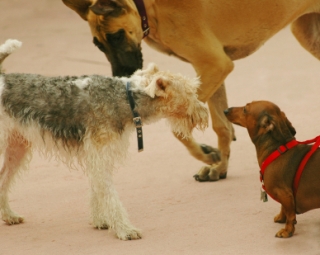
Different dogs have a wide array of play and communication styles.  Dogs come in many different sizes, colors, ages and personalities.  If a dog has only played with his siblings (dogs like him) and his roommate (perhaps a Beagle), he is going to be quite surprised and possibly confused the first time he’s face to face with a big, bouncy Boxer!

Before a dog is 5 months old, he needs to meet a wide variety of dogs!  Big dogs, little dogs, young dogs, old dogs, bouncy dogs, roly-poly dogs, barky dogs, yappy dogs, quiet dogs, brown dogs, white dogs, brindle dogs, fuzzy dogs, dogs that like to chase, dogs that like to be chased, dogs that don’t want to play at all…getting the idea?

Now wait, I can’t end there.  Remember, socialization is a process and that process doesn’t end after puppyhood.  It’s imperative that a well-socialized pup continues to meet other dogs throughout adolescence.  Otherwise, that great foundation you’ve started will start to unravel quickly. 

If you’re new to Dog Star Daily, check out the information on puppy socialization and adolescent changes in the Digital Training Textbook.  If you’ve been here a while, I’m betting you know someone who needs to read it.

 

Excellent

Yes, I  hear this all the time.  

And it is not just a matter of needing to meet more dogs... it's a matter of learning skills for meeting strange dogs.  Many dogs are fine with dogs they know, lousy with strange dogs.  If a strange dog can survive the hazing to become familiar, then it becomes a friend.  But that doesn't change our dog's ability to cope gracefully with brand new dogs.  I generally consider "strange dog fear/aggression" to be totally separate from intrahousehold dog aggression; they are essentially unconnected.  

So just because a dog may be fine with any number of dogs he knew as a puppy, or has gotten to know, that does not mean he is good with strange dogs. 

Greta Kaplan, CDBC, CPDT* Companion Animal Solutions* Portland, OR USA

Good point

Yes, negotiating greetings and getting to know a new dog is the skill we're really after, isn't it?  I also find great value in dogs being around dogs who don't want to play.  I like your use of the word gracefully...that's it!  Dogs who can gracefully walk away from a snark or a correction are ahead in the socialization game.

Great Article

Great article, Cindy.  I haven't run 'Puppy Socialisation' classes for years.  Pups join our multi-age/multi-breed Walk Clubs from the get-go, fully supervised and with a close eye on the interactions, WITHOUT any other dogs in their family for the very reasons stated in your article.

~Jaq~ www.dogpsyche.co.uk

I pass the AVSAB position

I pass the AVSAB position paper on puppy socialization along to anyone who will listen!  Vets and breeders are still telling puppy owners to wait until their dog has all its shots.  I don't know about you, but I see more dogs sent to the dead bin at shelters for aggression than I ever see die of parvo.  So, at least in my neck of the woods, the benefit of socialization outweighs the risk!  We do have puppy socialization classes, but we also have continuing play groups with different dogs in them each week, and we advise all our clients on the importance of "front end loading" the social experiences their puppies get.

We have been discussing play

We have been discussing play behavior on Patricia McConnell's blog.  Fascinating stuff!  Dr. McConnell has a video on her blog of her Border Collie, Will, playing with another dog that is very interesting.

http://www.theotherendoftheleash.com/


dogs not so good with other dogs

my dog sometimes reacts aggressively she is a border collie and even though she meets lots of other dogs sometimes something sets her off.

how can i train her away from that behaviour ?

It depends...

You know, we people don't like everyone we meet throughout our lifetimes, so it would be too much to expect our dogs to like every dog they meet.

Some dogs are more particular than others about greeting styles, play styles and who they choose to be friends with.  Without seeing your dog myself, it's hard to know if this is really aggression, reactivity or simple selectiveness. 

I would suggest finding a Certified Pet Dog Trainer in your area to take a look at your dog's behavior and help you teach your dog how to handle those encounters with dogs she may not take a fancy to.  You can find a trainer at www.apdt.com.

~Cindy

Dog Star Daily® Recomended Products:

  • My Dog Can Do That!
    My Dog Can Do That!
     
  • Really Reliable Recall - Train Your Dog to Come When Called... No Matter What! cover image
    Really Reliable Recall - Train Your Dog to Come When Called... No Matter What!
     
  • Dog Language: An Encyclopedia of Canine Behavior cover image
    Dog Language: An Encyclopedia of Canine Behavior
     
  • Dog Aggression: Biting (VIDEO)
    Dog Aggression: Biting (VIDEO)