
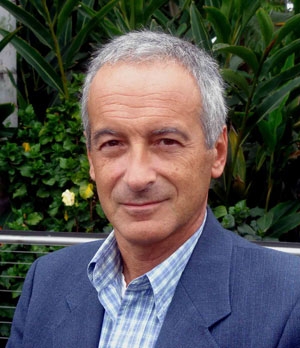
Dr. Roger Abrantes
Roger Abrantes, PhD in Evolutionary Biology and Ethology, and BA in Philosophy, DHC, DF, MAPBC, born in Portugal in 1951, has lived most of his life in Denmark.He is the author to 17 books in English, German, Spanish, Danish, Swedish, Norwegian, Italian, and Czech, and innumerous articles on behavior. He is probably one of the most versatile ethologists in the world.
His work ranges from lecturing at the Etologisk Institute, where he is the scientific director, to appearances as guest lecturer in universities world wide, popular talks, treatment of behavior problems, as well as teaching canine and human behavior to police officers.
He has written popular books with sound advice to pet owners as well as theoretical scientific dissertations. He teaches ethology, anthropology, and epistemology (theory of knowledge), besides his practical work with dogs and horses.
He is a popular guest in TV and radio programs in his home countries and in the US. His English books Dog Language–An Encyclopedia of Canine Behavior and The Evolution Of Canine Social Behavior became hits the moment they reached the US bookshelves. He lectures often in the US.
Dr. Abrantes is especially known for his views on social behavior and its applications to the daily understanding of pet behavior; and for his no-nonsense working methods, a practical and thorough application of Ethology and Learning Theory, teaching the animal the new patterns patiently and efficiently step by step.
His actual work comprises marine biology environmental management in Thailand, diving every day looking after corals and fish, and the supervision of the training of landmine detecting rats in Tanzania.
Roger Abrantes is truly a citizen of the world. If you ask him where he lives, he will answer you 'Planet Earth' and there's something about it. He lives though most of the time on an island, which name he refuses to reveal, in the south of Thailand. He speaks nine languages, English, Portuguese, French, Danish, and Swedish (fluently), Spanish, Italian, German, and Thai (less fluently).
He is also keen sportsman, having raced cars for many years. He has also played roller hockey in the German Bundesliga where he was his team's first goal-keeper until a few years ago. Nowadays he runs 10 ks and when he's not working, he dedicates himself to his two life-long passions: reading (everything) and listening to music (Blues, Rock, New-Age).

More by Roger Abrantes
April 13th, 2007 by Roger Abrantes
Walking on my way home from the pier is a pleasure. A stride of normally 20 minutes, but not uncommonly it takes me one hour or even two because I have to chat with everybody on the way, from merchants to people I’ve seen a couple of times before, or even complete strangers. This is the Thai way and this is my village in Southern Thailand where everybody smiles and talks to everybody.
December 2nd, 2007 by Roger Abrantes
We are used to it by now. Well, we still wake up, but then we fall asleep quickly again. The first time you hear them, you get a scare. It’s a mixture of yelling, crying, whining, and howling with intermittent, barely recognizable barking sounds. It sounds desperate and urgent and you don’t know what’s happening. The only times now we don’t go back to sleeping right away is when there’s a bit more urgency or desperation than usually in all that cacophony of sounds. With time, you learn to recognize this tiny difference in urgency.
December 20th, 2007 by Roger Abrantes
Mickey is an unusual Thai dog because he doesn’t look like all the others. He’s a Shih-Poo, a mix between a Shih Tzu (or 獅子狗 Chinese = lion dog) and a Poodle. Both breeds are relatively popular in Thailand, if you can say that any breed is popular in Thailand. Thais have a tendency of just letting things happen, so since Gai had a dog of each breed and they happened to be of different sexes, it happened sooner rather than later. The puppies were oh so cute and all went to good homes. Amongst much Southeast Asian giggling, Mickey went to Gung, who’s a nurse.
January 14th, 2008 by Roger Abrantes
Returning to Europe after a time in Asia and Africa is always a mixed experience for me. I’m looking forward to it, sometimes almost with a childish anticipation, and yet the harsh reality strikes me from the very first moment I land in Kastrup Airport in Copenhagen. Passport control: I show my passport, which the officer meticulously examines taking glances at me. ‘Why are you laughing?’ he asks. ‘Oh sorry,’ I hasten to say, ‘I’m not laughing, I was just smiling because I just came from a place where people smile to one another all the time.’ I had forgotten that in the West, you’re not allowed to smile to one another.
January 19th, 2008 by Roger Abrantes
Next stop is Portugal. I stay with my sister in Oeiras, on the beautiful Lisboa—Cascais coast. My sister was so fortunate to buy a house there, many years ago, when real estate prices were right. I always look forward to staying there, only 100 meters to the beach and the great Atlantic Ocean.
We have a good fresh seafood dinner in one of those restaurants that look like nothing but where the food is just divine. A walk home along the shore is just what I need before going to bed to get a good night’s sleep after a day of traveling with flight delays and overcrowded airports.
Lying in my bed, window half open, allowing some moonlight in the room, and especially the rhythmic sound of the Atlantic Ocean waves softly beating the cliffs, is the best lullaby one can wish, and a few moments later, I guess, I’m asleep. ‘Good to be home’, is my last thought, for even though I haven’t lived in Portugal since I was nineteen, a part of it always feels like home.
January 30th, 2008 by Roger Abrantes
We all know Rikki-Tikki-Tavi, the brave mongoose from Kipling’s ‘The Jungle book’. This is the story of Mah Noy, the brave dog from Koh Lanta Yai in Southern Thai.
Koh Lanta Yai (เกาะลันตา) is still a well-kept secret of Thailand (I shouldn’t even reveal the name). Relatively close to the much more known Koh Phuket and Koh Pi Pi, but virtually inaccessible unless you want to take two flights, a long drive, and sail twice, this South Andaman island is definitely not overrun by tourists and almost devoid of western influence except for a few resorts for those who want a taste of unspoiled paradise. Koh Lanta Yai is the biggest of 52 islands of which only 12 are inhabited.
|